Localvolts vs Amber: who keeps the difference?
Localvolts and Amber both sell wholesale power, but in one Queensland price spike they bought and sold at different prices. Where the gap goes, and why it matters for your battery.
Wholesale energy11 min read
By the Sunnn design team
The short version
- Amber and Localvolts both say they give you the wholesale price. In one five-minute price spike in Queensland, Amber's buy price was 4.2c/kWh higher and its sell price 4c/kWh lower than Localvolts'.
- Amber adds a charge it calls Price Protection Hedging to the wholesale price of the power you buy, all year. We could not find a published figure for its size. Localvolts says it adds no mark-ups.
- Amber is a venture-backed company that has raised hundreds of millions of dollars to build a fleet of home batteries it controls. A $25 monthly fee is not what pays for that.
- If you own a battery, the price spikes are where your money is made. It pays to know who keeps the difference.
Same market, two different prices
Both Amber and Localvolts are electricity retailers that pass the wholesale market price through to you, every five minutes, in both directions. When you buy from the grid you pay the price for that five minutes. When your solar or battery sells to the grid, you are paid the price for that five minutes. If you are new to how that works, start with Wholesale electricity plans, explained simply.
So you would expect the two to show the same price at the same moment. Here is one example, shared with our team, from a single five-minute price spike in Queensland a few weeks ago.
| Same five minutes, Queensland | Localvolts | Amber | Gap |
|---|---|---|---|
| Price to buy from the grid | 62.3c/kWh | 66.5c/kWh | Amber 4.2c higher |
| Price paid to sell to the grid | 42c/kWh | 38c/kWh | Amber 4c lower |
Think of two shops selling the same apple from the same orchard. One charges what the orchard charges. The other adds a bit on when you buy, and pays a bit less when you sell it apples back.
Why a few cents matters when you own a battery
A few cents sounds small. On a home battery it is not, because of when it happens.
A battery on a wholesale plan makes most of its money in a handful of moments: the evening spikes, when it sells for dollars rather than cents. That is the whole point of trading it. If a retailer pays you a little less than the market every time you sell, and charges a little more every time you buy, the gap comes out of your best moments, over and over.
As an illustration, our own modelling has a trading home battery selling around 6,000 to 7,000 kWh a year into the grid. At just 1c a kWh, that is $60 to $70 a year from selling alone, before the buying side, and it repeats every year the battery lives on your wall. Your numbers will differ.
What sits between the market price and your bill
Here is what each company says about it, in its own words.
Amber says it passes through wholesale prices "at the cost to us", and that this includes "hedging costs". Its help centre explains that it adds "a small charge for Price Protection Hedging to the wholesale price year-round which acts as a form of insurance against high prices", and links that charge to a bill guarantee. The guarantee, as Amber describes it, caps the average base wholesale part of your usage price over each quarter. The cap does not cover the hedging charge itself, network charges, metering or environmental costs.
Localvolts says all prices, costs and charges "are applied on a pass-through basis", and "we do not add any mark-ups". Its fee is a flat daily charge instead.
The key thing about Amber's charge is what we cannot see:
- How big it is. We could not find a published cents-per-kWh figure for it.
- Whether you can opt out. It is described as applying year-round. As far as we can tell, it is part of the plan, not an add-on you choose.
- When the guarantee pays out. It works on an average over a whole quarter. A battery home buys most of its power when it is cheap, so its average is unlikely to reach the cap, which means the guarantee may rarely pay out for the people paying the charge.
- What happens when a spike actually hits. A hedge works like insurance a retailer buys: a contract that pays out when market prices go very high. We could not find anything published on what hedges Amber buys, how much they pay out in a spike, or where those payouts go.
None of this means anyone is doing something wrong. It means you cannot check it. And you cannot compare two plans properly when one of the numbers is hidden.
"Protection" from spikes, when spikes are your payday
Amber describes the charge as insurance against high prices. Ask who that insurance is really for.
For a home without a battery, price spikes are a cost, and insurance against them makes sense. For a home with a battery that is trading, spikes are the opposite. They are payday. That is when your battery sells for the most.
So a battery owner on Amber pays a charge on every kWh they buy, all year, to protect them from the very thing their battery is designed to profit from. Meanwhile, if the retailer holds hedges that pay out when prices spike, the retailer is the one standing to gain from those moments.
That is the question worth asking any retailer, not just Amber: when prices spike, who keeps the difference, you or them? With a plan that passes the price straight through and shows its working, you can see the answer on your bill.
How does a $25 subscription build a company this big?
It does not, and it is not meant to.
Amber charges a membership of $25 a month, about $300 a year per home. Yet it has raised about A$209 million in equity funding from investors, according to a September 2026 report on its latest round. That latest round was a €49 million Series E led by Morgan Stanley's 1GT climate strategy, with the German energy giant E.ON joining in. Amber's technology already runs E.ON Next's "Next Optimise" tariff in the UK.
Investors put in that kind of money for a bigger prize than monthly fees. Amber manages more than half of Australia's automated home batteries. As one report on the raise put it: "One battery is a product. Thousands become infrastructure."
In plain words: tens of thousands of home batteries, all controlled by one company's software, add up to something that behaves like a power station. That is valuable to energy companies, to the grid and to investors, and Amber is selling that platform overseas.
There is nothing wrong with building that. Lots of good companies are built on investor money. But it is worth understanding what you are part of. When you hand over control of your battery, you become part of someone else's power station. The value of that power station has to come from somewhere: from fees, from the gap between the prices you see and the market, and from what the fleet as a whole can earn.
What Localvolts is trying to do differently
Localvolts takes almost the opposite approach. It calls itself "a new type of energy company operating an open electricity marketplace where you have full control over the purchase and sale of your energy."
- Price passed straight through. It says every price, cost and charge is passed through with no mark-ups.
- A flat daily fee. $1.10 a day for homes, about $401.50 a year. The fee does not grow with how much energy you trade.
- A marketplace. In its words, "you control the price you pay for your energy, when you buy, and who you buy from".
- It does not control your battery. Localvolts has no battery control or app of its own. It leaves that to partners, such as installers, who look after the customer and the equipment.
So Localvolts is the shop that charges what the orchard charges. What it does not do is run your battery for you. That is the gap we built Sunnn+ to fill.
The honest trade-offs
We would rather you pick the right plan than the one that suits us, so here is the other side.
| Amber | Localvolts | |
|---|---|---|
| Fixed fee | $25 a month, about $300 a year | $1.10 a day, about $401.50 a year |
| Hedging charge on power you buy | Yes, size not published | None stated, no mark-ups |
| Battery control | SmartShift, included | None of its own, done by a partner like Sunnn+ |
| Bill guarantee | Yes, caps the base wholesale price averaged over a quarter | No |
| Set your own trading price | No | Yes |
- Localvolts' fixed fee is about $100 a year higher. For a small home that buys little power from the grid, Amber can work out cheaper overall.
- Amber is one company for everything. Some people value having the plan and the battery control in one place. With Localvolts you deal with two parties: Localvolts for the power, and a partner for the battery.
- Amber's guarantee is a real safety net. If you want it, that is a reason to choose Amber, as long as you understand you are paying for it on every kWh you buy.
- Neither is right for every home. A home with solar and no battery is often better off on a good fixed plan. Wholesale plans pay when a battery is trading.
Check it on your own bill. Pull up the per-interval prices your retailer charged you during the last evening spike and compare them with the published AEMO spot price for your state at the same five minutes. If you cannot work out the gap from your bill, that tells you something too.
Where Sunnn+ fits
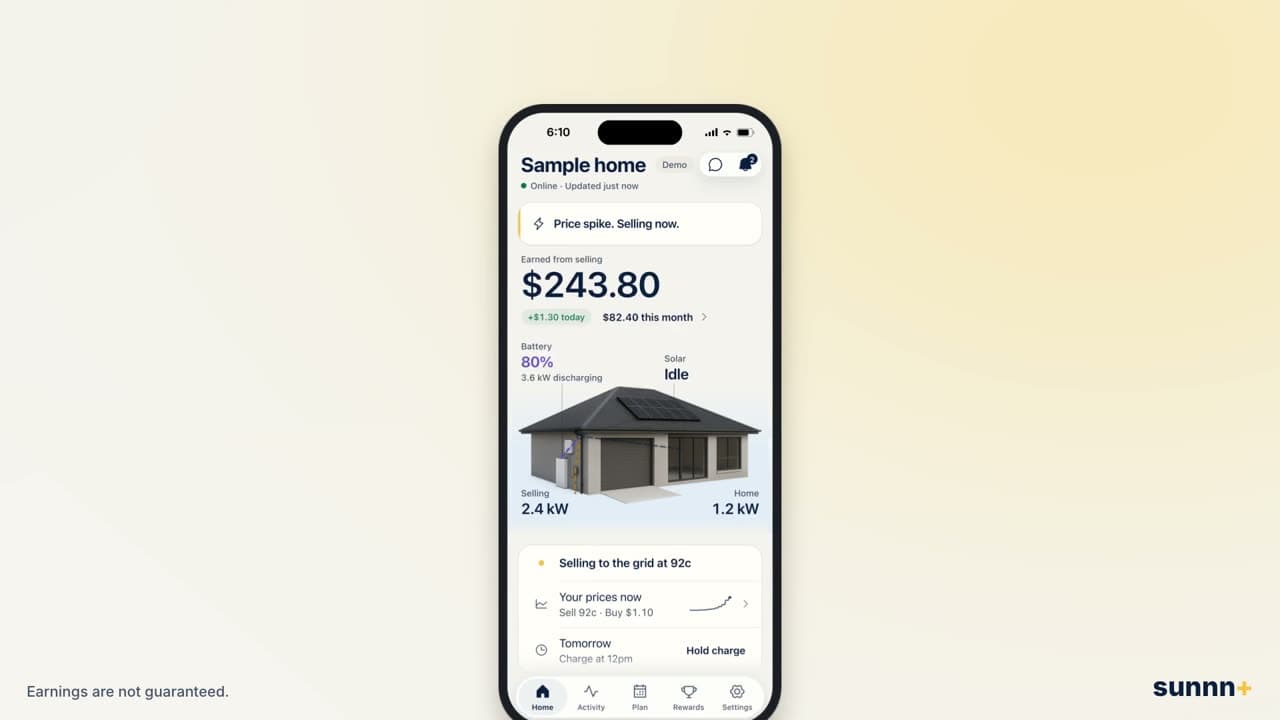
Sunnn+ is our free app that trades your home battery on Localvolts prices. It is the piece Localvolts leaves out: battery control.
- Free. There is no Sunnn+ subscription. Localvolts charges its own daily fee, and your normal electricity charges still apply.
- Every five minutes. It watches live Localvolts prices, charges when power is cheap and sells when prices spike.
- Inside your limits. You set the reserve it keeps for your home and how much it can export, and you can see every trade in the app.
- Fox ESS earns today. SAJ, Deye and Sunsynk we can connect on request. Localvolts covers the ACT, NSW, Queensland, South Australia and Tasmania.
- Earnings are not guaranteed. Prices move, and some months are better than others.
One thing to know if you are on Amber now: Sunnn+ works with Localvolts only, so moving to Sunnn+ means leaving Amber, and SmartShift will stop running your battery.
[Get Sunnn+ free](/plus), or talk to us about whether a battery and wholesale plan make sense for your home at all.
We are not an electricity retailer. Sunnn designs and quotes solar and battery systems, arranges installation through accredited installers, and is a Localvolts partner.
Common questions
Is Amber's price the real wholesale price?
Amber says it passes through wholesale prices at its cost, and that this includes hedging costs. Its help centre says it adds a small charge for Price Protection Hedging to the wholesale price year-round. So the price you pay to buy includes that charge on top of the market price. We could not find a published figure for how big the charge is.
What is Amber's Price Protection Hedging charge?
A charge Amber adds to the wholesale price of the power you buy, all year, which it describes as a form of insurance against high prices. Amber links it to a guarantee that caps the average base wholesale part of your usage price over each quarter. We could not find a published figure for the size of the charge.
Is Localvolts cheaper than Amber?
It depends on the home. Localvolts' fixed fee is about $100 a year higher ($1.10 a day against Amber's $25 a month), but it says it adds no mark-ups to the energy price. A home with a battery that buys and sells a lot of energy usually feels the per-kWh difference more than the fixed fee. A small home that buys little from the grid can be cheaper on Amber.
How does Amber make money with a $25 fee?
The fee is only part of it. Amber is venture-backed and has raised about A$209 million in equity, including a €49 million round in September 2026 led by Morgan Stanley's 1GT strategy with E.ON. It also licenses its battery-control technology to energy companies overseas, such as E.ON Next in the UK, and adds a hedging charge to the power its customers buy.
Can I use Sunnn+ with Amber?
No. Sunnn+ trades on Localvolts prices only. Amber runs its own battery control, SmartShift, and only one system can control a battery at a time, so moving to Sunnn+ means moving your account to Localvolts.
Sources
- Amber Electric: How Amber works (membership fee and what is passed through)
- Amber help centre: Price Protection Hedging and the Quarterly Bill Guarantee
- Amber help centre: Does Amber offer any kind of price protection?
- Localvolts: How it all works (fees and no mark-ups)
- ESS News: Amber Electric raises €49 million to expand into Europe (22 September 2026)
- TechStartups: Amber Electric raises €49M, total equity funding about A$209 million (21 September 2026)
- RenewEconomy: Amber raises $45m to accelerate global expansion (June 2025)
- AEMO: National Electricity Market data dashboard
General information only, not financial advice. Rebates and market rules change; check the sources above for the current position. Any savings figures are modelled estimates, not guarantees. See our disclosures.